What are nutrients used for?
Carbohydrates are the primary source of energy. They spare the body from breaking down protein.
Proteins are essential for growth, repair and maintenance. They are also used for energy production and regulatory functions.
Fats are a source of energy, and act as insulation. They also provide padding for protection of vital organs.
Minerals (magnesium, iron, calcium) are needed to build body tissues and regulate body fluids. Some can be toxic if taken in excess.
Vitamins facilitate the metabolism (breakdown for body’s use) of fats, proteins and carbohydrates. Some (vitamin A, D, E, K) can be toxic if taken in excess.
How much of the nutrients are needed daily? (based on a 2,000 calorie diet)
- Carbohydrates (CHO) – 50% of calories. 1 gram of CHO = 4 calories
- Fat – 30% of calories. 1 gram of fat = 9 calories
- Protein – 15-20% of calories. 1 gram of protein = 4 calories
Choose sensible portion sizes
Overeating is a leading cause for the rising number of obese children and adults.
- If you are eating out, choose small portion sizes, share an entrée with a friend, or take part of the food home.
- Check product labels to learn how much food is considered to be a serving, and how many calories, grams of fat, and so forth are in food. Many items sold as single portions actually provide 2 servings or more.
- Be especially careful to limit portion sizes of foods high in calories, such as cookies, cakes, other sweets, french fries, and fats, oils and spreads.
What counts as a serving?
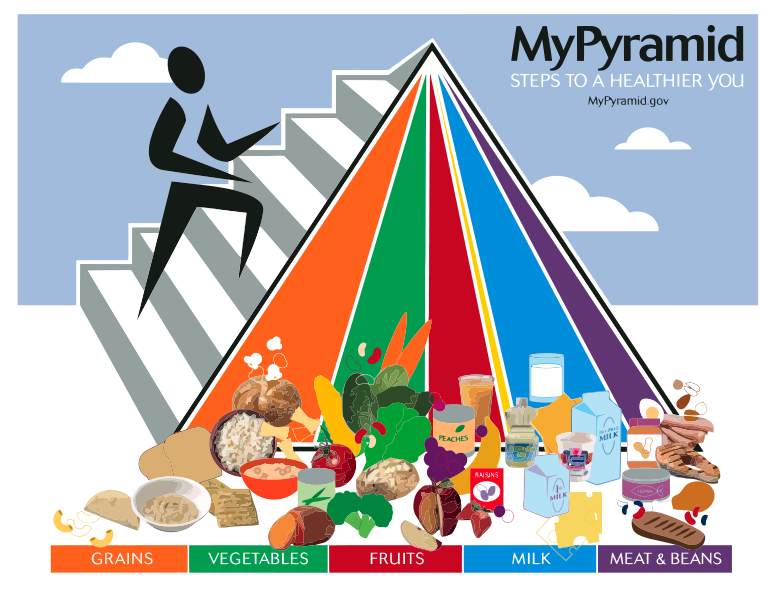
Bread, Cereal, Rice and Pasta Group (Grains Group) – whole grain and refined
- 1 slice of bread
- about 1 cup of cooked cereal, rice or pasta
Vegetable Group
- 1 cup of raw leafy vegetable
- 1/2 cup of other vegetables – cooked or raw
- 3/4 cup of vegetable juice
Fruit Group
- 1 medium apple, banana, orange, pear
- 1/2 cup chopped, cooked or canned fruit
- 3/4 cup of fruit juice
Milk, Yogurt and Cheese Group
- 1 cup of milk or yogurt
- 1-1/2 ounces of natural cheese (such as cheddar)
- 2 ounces of processed cheese (such as American)
Meat, Poultry, Fish, Dry Beans, Eggs and Nuts group
- 2-3 ounces of cooked lean meat, poultry or fish
- 1/2 cup of cooked dry beans or 1/2 cup of tofu
- 2-1/2 ounce soyburger or 1 egg
- 2 tablespoons of peanut butter or 1/3 cup of nuts
Choose a diet that is low in saturated fats and cholesterol, and moderate in total fat.
Fats supply energy and essential fatty acids, and they help absorb the fat-soluble vitamins A, D, E, K and carotenoids. You need some fat in the food you eat, but choose sensibly. Some kinds of fat, especially saturated fats, increase the risk for coronary heart disease by raising the blood cholesterol. In contrast, unsaturated fats (found mainly in vegetable oils) do not increase blood cholesterol.[/toggle]
Know the different types of fats
Saturated Fats – foods high in saturated fats tend to raise blood cholesterol. These foods include high-fat dairy products (like cheese, whole milk, cream, butter and regular ice cream), fatty fresh and processed meats, the skin of poultry, lard, palm oil and coconut oil. Keep your intake of these foods low.
Dietary Cholesterol – foods that are high in cholesterol also tend to raise blood cholesterol. These foods include liver and other organ meats, egg yolks and diary fats.
Trans-Fatty Acids – foods high in trans-fatty acids tend to raise blood cholesterol. These foods include those high in partially hydrogenated vegetable oils, such as many hard margarines and shortenings. Foods with a high amount of these ingredients include some commercially fried foods and some bakery goods.
Unsaturated Fats – unsaturated fats do not raise blood cholesterol. Unsaturated fats occur in vegetable oils, most nuts, olives, avocados, and fatty fish like salmon. Unsaturated oils include both monounsaturated fats and polyunsaturated fats. Olive, canola, sunflower and peanut oils are some of the oils high in monounsaturated fats. Vegetable oils such as soybean oil, corn oil and cottonseed oil, and many kinds of nuts are good sources of polyunsaturated fats. Some fish, such as salmon, tuna and mackerel contain omega-3 fatty acids that are being studied to determine if they offer protection against heart disease. Use moderate amounts of food high in unsaturated fats, taking care to avoid excess calories.
[/toggle]
Choose whole grain foods
Vitamins, minerals, fiber and other protective substances in whole grain foods contribute to the health benefits of whole grains. Refined grains are low in fiber and in the protective substances that accompany fiber. Eating plenty of fiber-containing foods, such as whole grains (and also many fruits and vegetables) promotes proper bowel function. The high fiber content of many whole grains may also help you feel full with fewer calories. Fiber is best obtained from foods like whole grains, fruits and vegetables rather than from fiber supplements. Fiber in the diet may decrease the risk of colon cancer. A colonoscopy at the age of 50 is the recommended screening for colon cancer.
Choose a variety of fruits and vegetables daily
Fruits and vegetables are key parts of your daily diet. Eating plenty of fruits and vegetables of different kinds may help protect you against many chronic diseases. It also promotes healthy bowel function. Fruits and vegetables provide essential vitamins and minerals, fiber and other substances that are important for good health. To promote your health, eat a variety of fruits and vegetables – at least 2 servings of fruits and vegetables each day.
Which fruits and vegetables provide the most nutrition?
Sources of Vitamin A (carotenoids)
- Orange vegetables like carrots, sweet potatoes, pumpkin
- Dark green leafy vegetables such as spinach, collards, turnip greens
- Orange fruits like mango, cantaloupe, apricots
- Tomatoes
Sources of Vitamin C
- Citrus fruits and juices, kiwi fruit, strawberries, cantaloupe
- Broccoli, peppers, tomatoes, cabbage, potatoes
- Leafy greens such as romaine lettuce, turnip greens, spinach
Sources of folate
- Cooked dry beans and peas, peanuts
- Oranges, orange juice
- Dark green leafy vegetables like spinach and mustard greens, romaine lettuce
- Green peas
Sources of potassium
- Baked white or sweet potato, cooked greens (such as spinach), winter (orange) squash
- Bananas, plantains, dried fruits such as apricots and prunes, orange juice
- Cooked dry beans (such as baked beans) and lentils
Growing children, teenagers, women and older adults have higher needs for some nutrients
Some source of calcium
- Yogurt
- Milk – skim or 1%
- Natural cheese such as mozzarella, cheddar, Swiss and Parmesan
- Soy-based beverage with added calcium
- Tofu, if made with calcium sulfate
- Breakfast cereal with added calcium
- Canned fish with small bones such as salmon and sardines
- Fruit juice with added calcium
- Pudding made with lowfat milk
- Soup made with lowfat milk
- Dark green leafy vegetables such as collards, turnip greens
Some sources of iron
- Shellfish like shrimp, clams, mussels and oysters
- Lean meats (especially beef), liver and other organ meats
- Ready to eat cereal with added iron
- Turkey dark meat
- Sardines
- Cooked dry beans (such as kidney beans and pinto beans), peas (such as black-eyed peas) and lentils
- Enriched and whole grain breads
For additional information on nutrition:
www.usda.gov/cnpp
www.usda.gov/fns/nutrition.html
www.healthfinder.gov
www.cdc.gov